In the late 1920s, a new idea arrived in Norway from the south. It had come through the Bauhaus, through Le Corbusier, through the 1927 Weissenhof exhibition in Stuttgart — and it said, simply, that a building should be exactly what it needs to be and nothing more. Flat roofs. White render. Windows as wide as the light required. Form derived from function. The Norwegians called it funksjonalisme, and they took to it with quiet conviction.
The man who became its Oslo master was Arne Korsmo. Where other architects adopted the vocabulary, Korsmo understood the grammar. His buildings are rational but never cold, stripped but never bare — they have a clarity that only accumulates in value as you stand in front of them. This tour visits four buildings that define his legacy — and one by his most gifted student.
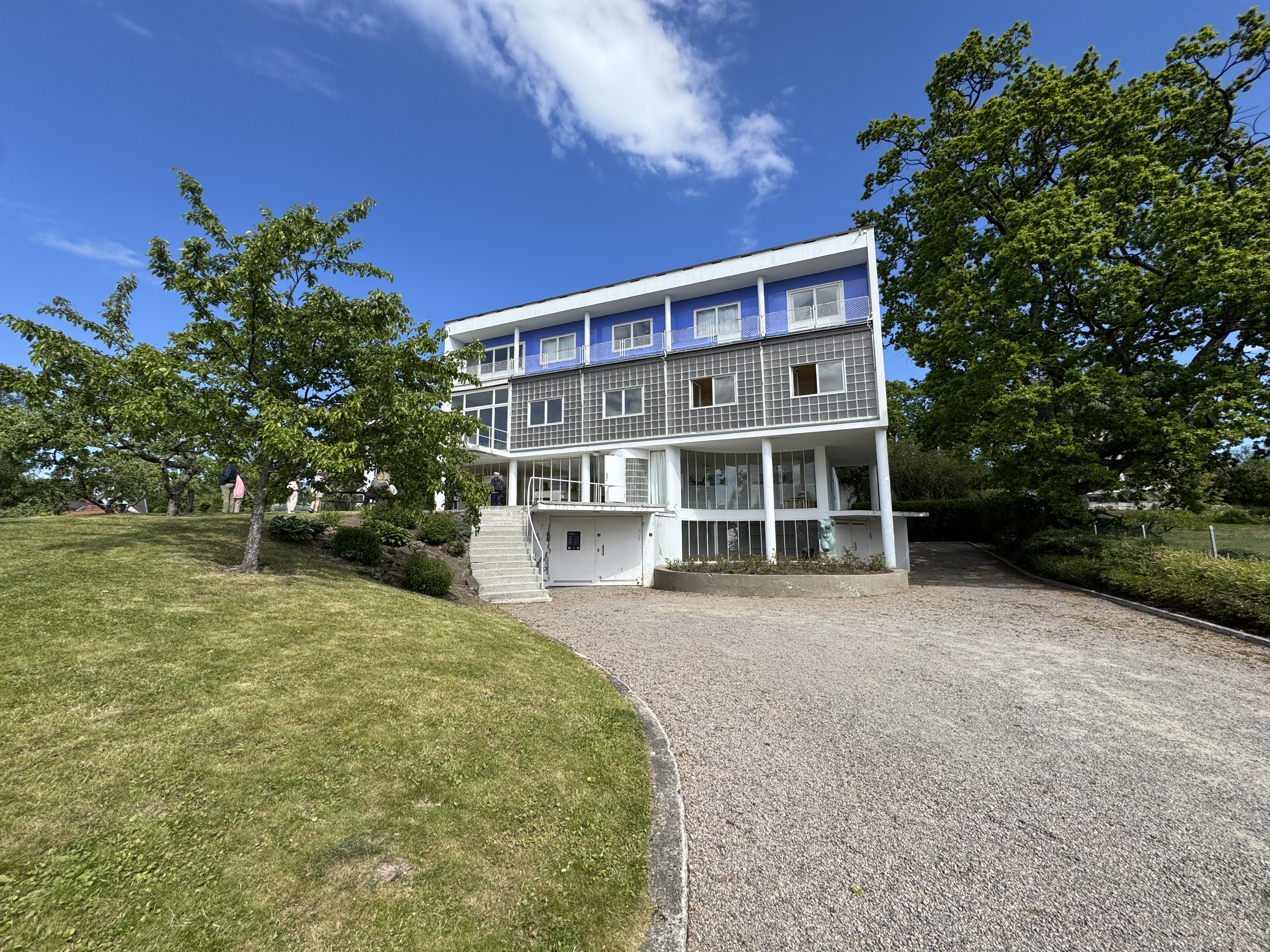
We start at Havna Allé 15, where Oslo's first functionalist housing development still stands largely as Korsmo designed it in 1930–32: a serene cul-de-sac of flat-roofed concrete villas with clean lines and no ornamentation, built when such ideas were genuinely radical on these streets. From here we ride to Villa Stenersen on Tuengen allé 10C — Korsmo's 1937–39 masterpiece, an open-plan villa of extensive glazing and a rooftop terrace built for art collector Rolf Stenersen. The National Museum now preserves it as a prime example of integrated modernism. It is the finest room in Oslo to stand inside and understand what functionalism was actually trying to say.
We continue to Planetveien, where Korsmo built not one house but three — numbers 12, 14 and 16 — between 1952 and 1955. His own home is among them. Set on a steep hillside, these wooden-and-glass structures blend functionalist clarity with a warmth and site-sensitivity that marks Korsmo's later thinking: less manifesto, more inhabitation. The fjord views from the slope are extraordinary.
Our final stop is Skådalsveien 33 — the School for Deaf Children designed by Sverre Fehn, Korsmo's most distinguished pupil, between 1971 and 1977. It is a brick-and-concrete building embedded quietly into the hillside, using spatial form, light and acoustics in ways tailored precisely to its users. Where Korsmo's buildings announce themselves, Fehn's listens. It is a poetic evolution of everything the tradition began — and a fitting place to end.