← All articles
Oslo by Bike: Best Routes and Sights
From the waterfront to the forest — what to ride and where it takes you
From the waterfront to the forest — what to ride and where it takes you
Oslo is an unusually good city to ride. The centre is compact, the main sights are close together, and the distances that take thirty minutes on foot take six minutes by bike. But the more interesting thing about cycling in Oslo is what you can reach that walking cannot easily get you to: the Bygdøy peninsula with its fjord views, and the Nordmarka forest to the north — genuine wilderness within fifteen minutes of the city centre.
Here is what the best routes cover, and what to expect from each.
This is the signature Oslo ride. It runs about 3 km along the waterfront from the Opera House in the east to Aker Brygge in the west, passing the new museum district, the old harbour and the castle. Flat, paved, separated from traffic for most of its length.
The Opera House is the obvious starting point — its sloping marble roof is designed for walking on and the views across the fjord from the top are good. From there, riding west along the water takes you past Tjuvholmen (a design and gallery district on a small peninsula) and into Aker Brygge, the old shipyard now lined with restaurants and bars looking south across the fjord.
This route is on every guided city tour for good reason. It covers the most visually interesting stretch of Oslo in one continuous movement.
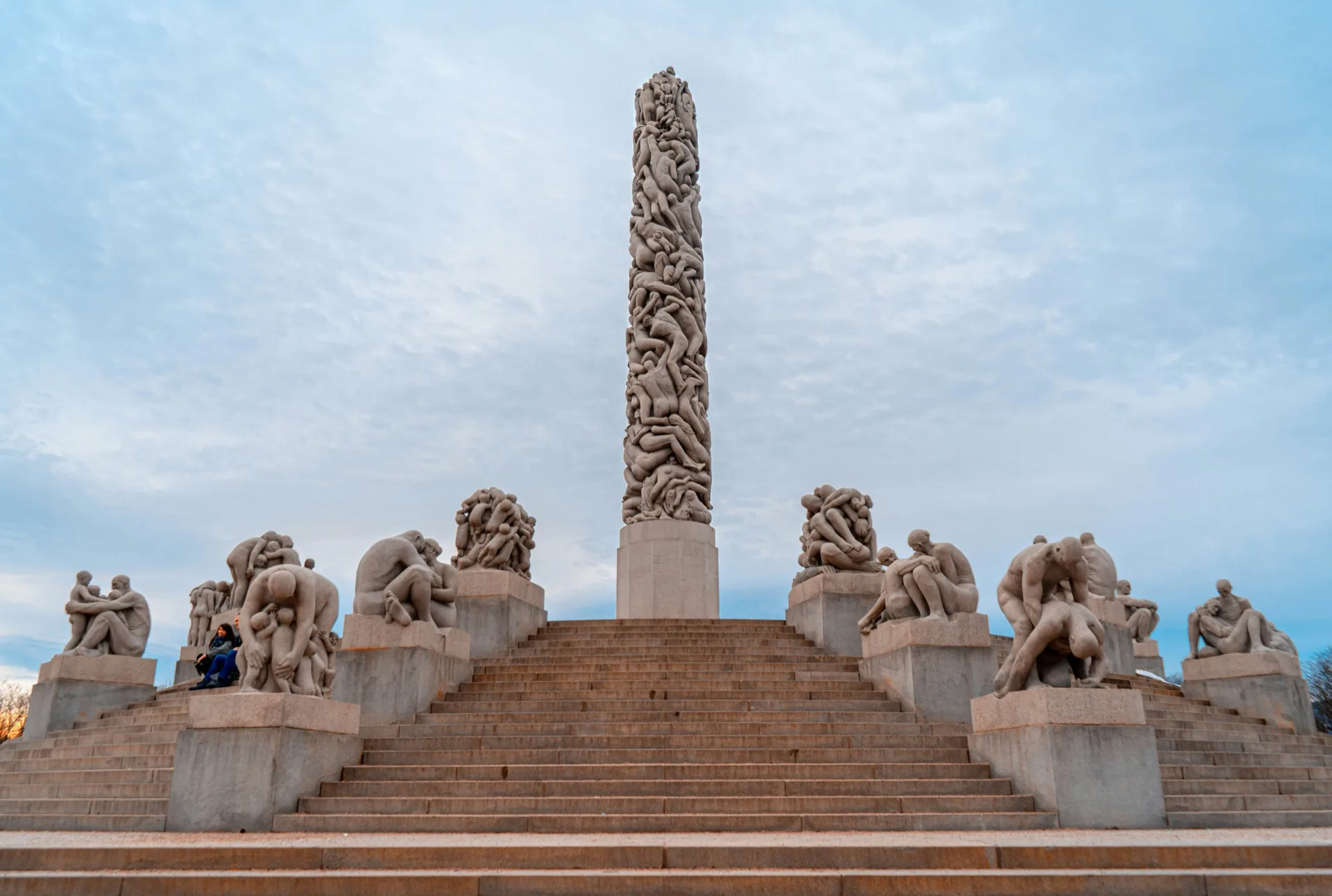
Vigeland Sculpture Park sits about 3 km north-west of Aker Brygge — twenty minutes on foot or six minutes by bike. It is bigger and stranger than photos suggest: 200 sculptures by Gustav Vigeland installed in a formal park, culminating in the Monolith, a 14-metre column carved from a single block of granite. Budget an hour to walk it properly.
The Royal Palace is a short ride from there, at the top of Karl Johans gate. The grounds are open and the view down the boulevard to the city centre is one of Oslo's best perspectives. The changing of the guard happens at 13:30.
Bygdøy is the peninsula to the west of the city, reached by a flat waterfront path from Aker Brygge — roughly 7 km each way. The ride is excellent: fjord views the whole way, passing royal estates and the beach at Huk before climbing gently to the museum cluster at the tip.
The Bygdøy Peninsula tour covers this route with a local guide. The Viking Ship Museum is closed for rebuilding and due to reopen as the Museum of the Viking Age in November 2027 — check current status before planning a visit. The Fram Museum (polar exploration ship) and the Norwegian Folk Museum are both on the peninsula and worth time.
Bygdøy works well as a half-day: ride out in the morning, spend time at the museums, ride back for lunch on the waterfront.
This is the route most visitors to Oslo never take — and the one that tends to be remembered longest.
The Nordmarka forest begins in Oslo's northern neighbourhoods and runs north for hundreds of kilometres. From a central hotel, the ride to the forest edge takes about fifteen minutes. Once you are in, the character changes immediately: pine and birch close in, the roads narrow to maintained gravel, and the city disappears. The trails fork and multiply, the lakes appear through the trees, and on a weekday morning you will often go an hour without seeing another person.
Four routes run into the forest from Oslo. The shortest — Oslo Gravel Short, 13 km, two hours — is an easy introduction suitable for any fitness level, with an e-bike option available. The Oslo Gravel Loop (25 km, three hours) takes you deeper with real climbing. The Nordmarka Forest Ring 4 is the classic local route: 50–55 km, four hours, with a waffle stop at the Kikutstua mountain cabin. At the far end, the Epic Marka Endurance — 85 km, a full day — pushes into country most Osloites have never seen.
A city bike is not suitable for the forest. You need a gravel bike or e-bike — you can rent a gravel bike in Oslo from NOK 699 with pickup right at Sognsvann, or book a guided tour with the bike included. The routes are unmarked for tourists, and ideally you want someone who knows the trails.
Oslo's city bike scheme (Oslo Bysykkel) covers the centre and works well for the waterfront and Vigeland routes. For Bygdøy or the forest, hire a better bike — most private hire shops are in the centre near Aker Brygge.
May through September is the best window. June and July are the driest. Autumn (September–October) brings colour to the birch trees in the forest. Spring (April–May) is the local favourite — the forest greens up fast and the trails are quiet.
A guided tour handles the bike, the route and the navigation. If you want to cover the city in two hours, add a forest ride in the afternoon, and have both tours start from your hotel — that is what we do.
We run private guided bike tours across all of these routes — city, fjord and forest. Hotel pickup included. Eight routes from two to six hours.
See all private toursYes. Oslo is compact, has cycling infrastructure in the centre, and borders a large forest to the north. The city routes are flat and easy; the Nordmarka forest routes range from gentle gravel trails to full-day endurance rides. It is one of the few cities where you can ride from your hotel to genuine wilderness in fifteen minutes.
The waterfront between the Opera House and Aker Brygge is the most scenic city route. The Bygdøy Peninsula path offers fjord views. Vigeland Park is a short ride from the centre. For something beyond the tourist circuit, the Nordmarka forest gravel routes start fifteen minutes north — the Oslo Gravel Short is the easiest starting point.
Oslo Bysykkel (city bikes) are available at docking stations across the centre — good for flat urban routes. For Bygdøy or the Nordmarka forest you need a better bike. Oslo Bike Tours offers gravel bike rental in Oslo from NOK 699 (pickup included at Sognsvann, Kjelsås or Huseby), plus guided tours from NOK 890 per person with the bike included.
Yes. The city centre routes are flat and easy. The entry-level forest route (Oslo Gravel Short, 13 km, 2 hours) is manageable for beginners on an e-bike. Road surfaces are good and cycling infrastructure in the centre is well-developed.
May to September. June and July offer the longest daylight and driest conditions. Autumn (September–October) brings colour to the birch trees in the Nordmarka forest. Spring (April–May) is the local favourite — the forest greens up quickly and the trails are quiet.