← All articles
The Oslo Forest Most Visitors Never Find
The Nordmarka forest — and how to get into it
The Nordmarka forest — and how to get into it
Oslo has a number on the front page of every travel guide: the Opera House, Vigeland Park, the Munch Museum. Fewer guides mention that four hundred square kilometres of forest begin fifteen minutes north of the city centre. The Nordmarka forest wraps around Oslo to the north and east — pine and birch, gravel roads, mirror-still lakes, waffle-serving mountain cabins. Most visitors spend a week in the city and leave without finding it.
Nordmarka — sometimes called the Marka — is the collective name for the forested hills that surround Oslo on three sides. The city grew up between the fjord to the south and the forest to the north, and Osloites have been disappearing into it on foot, skis and bikes for generations. It is not a manicured park. There are no entrance gates, no tourist maps posted at intervals. It is a forest — 400 km² of it — that the city happens to border directly.
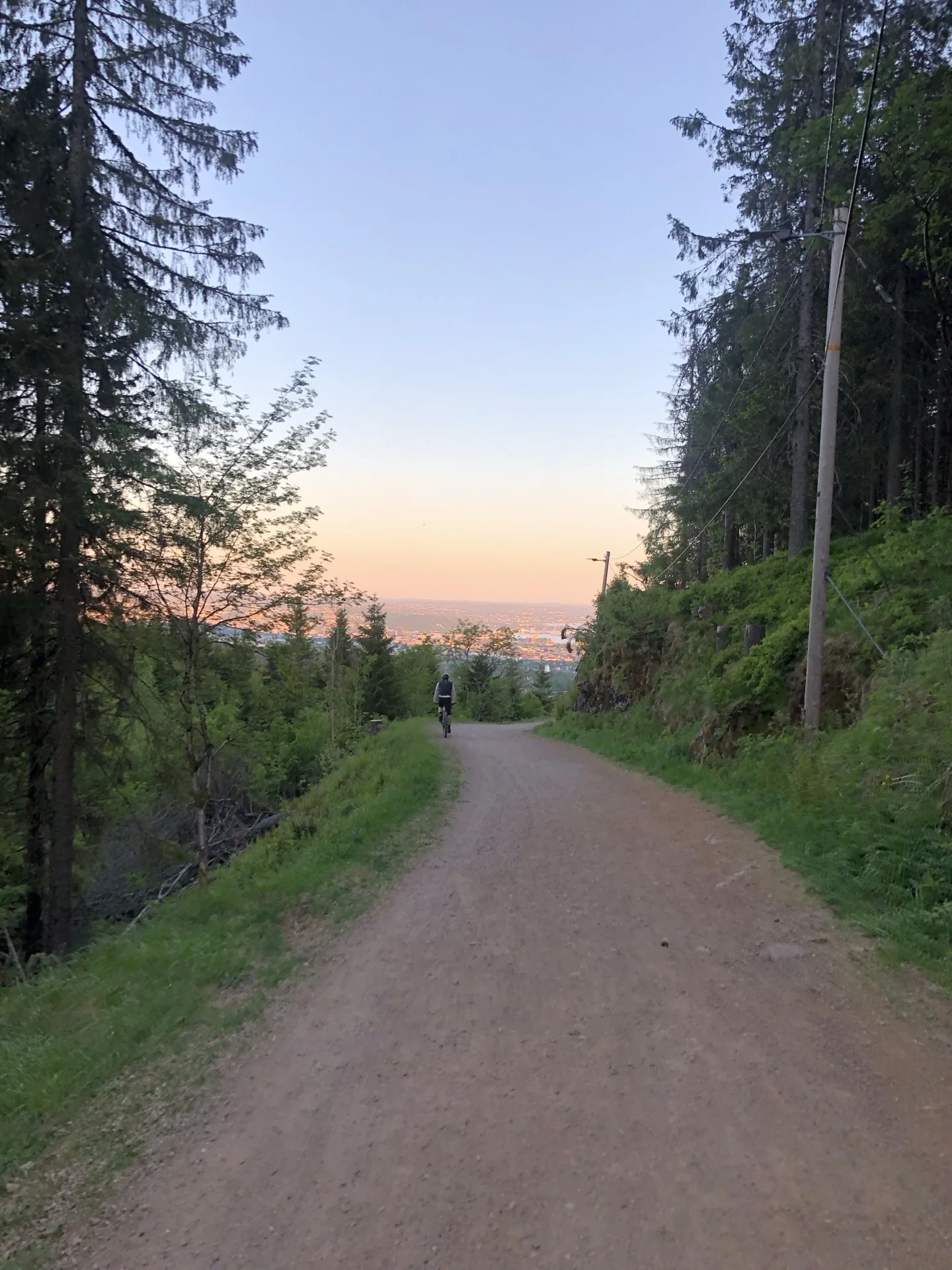
The terrain is rolling rather than alpine: long gravel climbs through stands of birch, ridgelines with views down over the lakes below, descents that run fast and quiet through the pines. The lakes — Maridalsvannet, Sandungen, Hakkloa — are clean and calm and surrounded by nothing. On a weekday morning you might not see another person for an hour.
There is no obvious door. The forest does not announce itself from the centre of Oslo. The entry points are in the northern neighbourhoods — Kjelsås, Maridalen, Sørkedalen — which are a metro ride or a bike ride from the hotel district. Once you get there, the trails fork and multiply without a clear hierarchy. Without local knowledge, it is easy to spend an hour on the wrong track and loop back to where you started.
The other barrier is the bike. City hire bikes work fine for the waterfront and the parks. For the Nordmarka, you need a gravel bike — wide tyres, clearance, a geometry that keeps you confident on loose descents. You can rent a gravel bike in Oslo from NOK 699, with pickup right at Sognsvann on the forest edge. Most visitors don't know this option exists, and end up on the wrong bike for the terrain. These are solvable problems. They just require someone who knows the place.
Pine and birch forest. A lot of it. The trees close in fast, and the quiet that follows is the kind that Oslo's residents come here specifically to find. Wildlife is common — red deer, elk and foxes all move through on their own schedule. The gravel roads are maintained and rideable in any weather. A few staffed cabins sit at intervals along the classic routes, serving coffee and vafler (Norwegian waffles); Kikutstua, on the Ring 4 loop, is the one everyone knows.
It changes as you go deeper. The first kilometre out of the city already feels different. By kilometre ten you are in another world entirely. That gradient — from urban edge to genuine wilderness — is something very few cities can offer, and Oslo does it in a quarter of an hour.
This is the most satisfying way to do it. You meet your guide at Sognsvann, the end of metro line 5, and within minutes you're off the road and into the trees. From there, how far you go depends on what you're after.
A first taste — two hours, thirteen kilometres of good gravel through pine and birch — is covered by the Oslo Gravel Short. Easy climbing, no technical sections. Suitable for families and first-time forest riders, on an e-bike or a standard gravel bike. Enough time in the trees to understand what the fuss is about.
If you want more distance and proper forest immersion, the Oslo Gravel Loop runs three hours and twenty-five kilometres. You reach the deeper sections — denser pine, higher ridges, occasional lakes through the trees — with real climbing and enough distance to feel like you have actually explored something.
The route that locals have ridden for generations is the Ring 4 — a 50–55 km loop, four hours, with a waffle stop at Kikutstua and the kind of distance that leaves you properly satisfied. That is the Nordmarka Forest tour. And at the far end of the scale is the Epic Marka Endurance: 85 km, a full day, into the parts of the forest that even most Osloites have never reached. Remote lakes, ancient logging roads, sustained climbing.
All four meet at Sognsvann (hotel pickup available on request). You bring yourself — the guide handles everything else. Prefer to explore solo? Rent a gravel bike or e-bike and ride the forest at your own pace. For a broader look at cycling options across the whole city, see our guide to the best cycling routes in Oslo.
The Oslo Gravel Short is the natural first step — thirteen kilometres of pine and birch, e-bike available, meeting at Sognsvann. A proper taste of the Marka forest without a full-day commitment. Or rent a bike and explore it yourself.
See the Oslo Gravel Short Bike rentalNordmarka — sometimes called the Marka — is a 400 km² forest that borders Oslo directly to the north and east. It contains hundreds of kilometres of gravel roads and trails, dozens of lakes, and a handful of staffed mountain cabins. Osloites use it year-round for hiking, skiing and cycling.
About fifteen minutes by bike from most central hotels. The forest edge begins in Oslo's northern neighbourhoods — Kjelsås, Maridalen, Sørkedalen — which are a short ride from the city centre.
Yes, but it takes preparation. There are no entry gates or tourist maps at the forest edge, and the trails fork and multiply without obvious hierarchy. Without local knowledge it's easy to take the wrong branch and loop back to where you started. A guide solves this — and handles the bike, the pickup and the route.
A gravel bike is the right tool for most routes — wide tyres handle the loose sections, and the geometry keeps you confident on descents. An e-bike gravel is the most popular choice for visitors, as it makes the climbs comfortable regardless of fitness. City hire bikes are not suitable for forest riding.
Oslo’s ring roads are numbered outwards from the centre, ending at Ring 3. Ring 4 is not a road at all — it is the name local cyclists gave the loop that runs further out still, through the Nordmarka forest, on gravel reachable only by bike or on foot. It is a classic 50–55 km loop that Oslo cyclists have been riding for generations — through pine and birch, past Kikutstua cabin, and back through the Maridalen valley. It is the most popular intermediate forest route in the city.
Yes, with the right route. The Oslo Gravel Short (13 km, 2 hours) runs on well-maintained gravel with gentle climbing — suitable for families and first-time forest riders. An e-bike makes the hills comfortable for anyone. The longer routes — Gravel Loop and Ring 4 — involve real climbing and suit recreational cyclists and above.